Single prompt, single response
Useful for drafting and question-answering, but limited when the job requires system access, repeatable steps, approvals or operational accountability.

Agentic AI orchestration studio
PearlQuest designs agentic AI orchestration systems for UAE, Saudi Arabia, GCC and global organizations — combining LLMs, RAG, APIs, workflow logic and human oversight into reliable automation layers.
Instead of building one chatbot, we architect coordinated AI agents that can retrieve enterprise knowledge, reason across steps, call tools, update systems and support real business workflows.
What it means
An agentic AI orchestration system is designed to manage intelligent agents that can work across multiple steps: understand the goal, retrieve the right knowledge, choose tools, call APIs, execute actions, ask for approval where needed and produce a traceable outcome.
Traditional AI often answers one prompt at a time. Agentic AI can be designed around tasks: checking a policy, reading a document, updating a CRM, drafting a report, escalating an exception or guiding a user through a business process.
PearlQuest builds the orchestration layer around your use case, data boundaries, approval rules and interface requirements so the AI system fits the real operating environment rather than remaining a disconnected demo.

Agentic AI explained
The difference is not just intelligence. It is architecture: memory, retrieval, tool-calling, structured workflows, validation, user permissions and human-in-the-loop control.
Useful for drafting and question-answering, but limited when the job requires system access, repeatable steps, approvals or operational accountability.
An agent can retrieve knowledge, follow instructions, call external tools, remember context and execute defined actions inside a controlled workflow.
Orchestration coordinates specialized agents, data sources, business rules, model choices, logs, guardrails and user interfaces into a practical enterprise AI layer.
Capabilities
We combine AI architecture, UX, backend logic and integration thinking so agentic AI systems can serve real users, real teams and real workflows.

Design AI agents for support, operations, analytics, sales, marketing, training and internal knowledge workflows.
Build retrieval pipelines from documents, SOPs, PDFs, websites, databases and internal knowledge bases.

Connect agents to APIs, forms, CRMs, ERP systems, dashboards and business software to move work forward.

Coordinate planner agents, retrieval agents, task agents, QA agents and human-approval paths for complex processes.

Deploy to cloud platforms, private servers or hybrid infrastructure depending on security and performance needs.

Add logs, confidence handling, approval flows, fallback paths, testing loops and responsible operating controls.
Technology stack
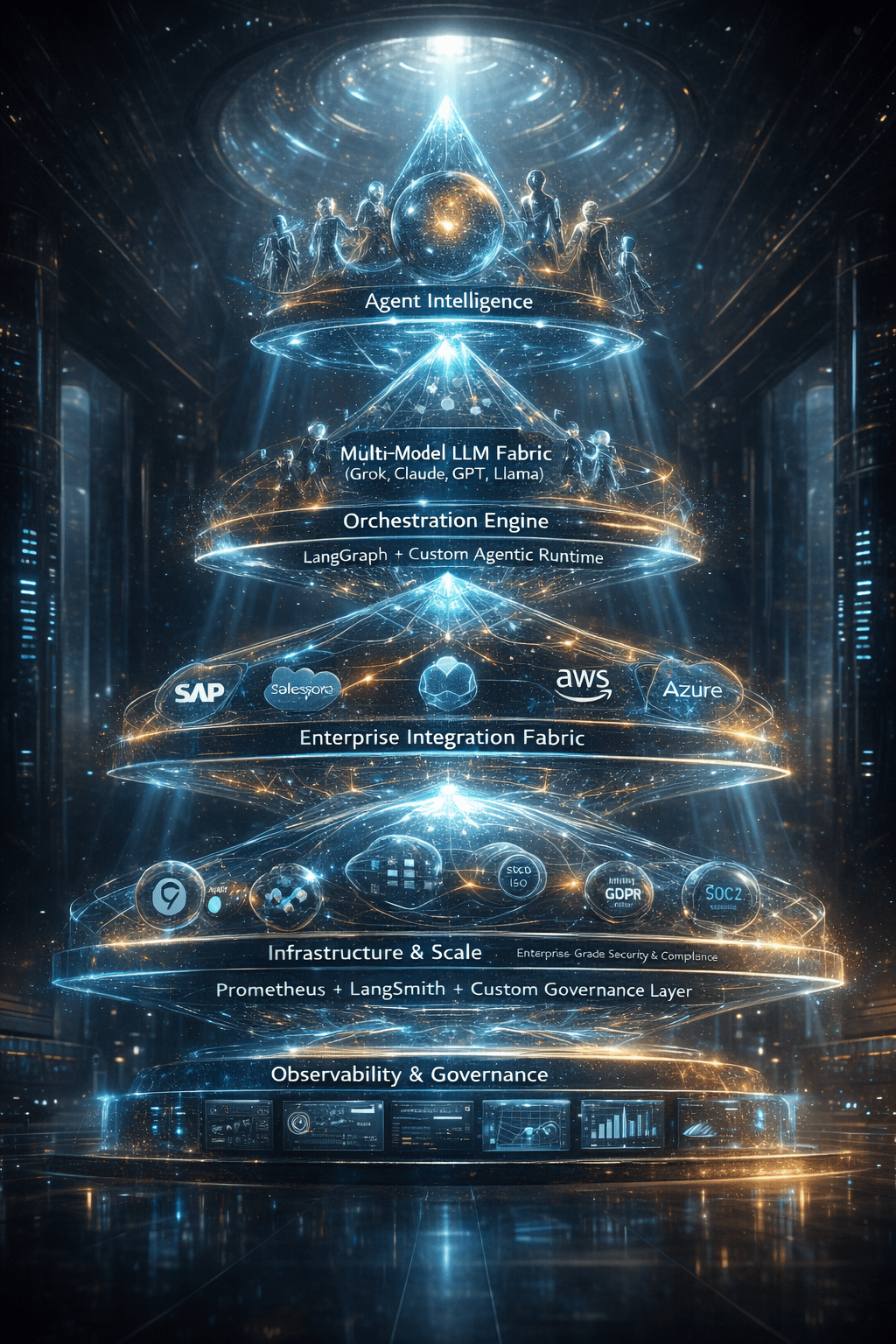
Our stack can combine OpenAI, Claude, Gemini and open-source LLMs with orchestration frameworks such as LangChain, LlamaIndex, Semantic Kernel and custom Python or Node.js logic. The exact architecture depends on security, latency, accuracy, deployment and integration requirements.
For enterprise knowledge workflows, we can implement RAG pipelines using vector databases and controlled retrieval from documents, databases, websites and internal systems. The AI layer can connect to web apps, dashboards, kiosks, XR environments and immersive installations where useful.
Implementation path
Agentic AI projects fail when they start as vague demos. We structure the work around a specific business outcome, trusted data, controlled actions and measurable adoption.
Identify high-friction tasks, data sources, approval points, user roles and risks.
Build a focused MVP around one workflow, one knowledge set and one clear outcome.
Integrate APIs, databases, documents, dashboards, CRMs, forms or operating systems.
Introduce permissions, validation, logs, fallback paths and human-in-the-loop control.
Launch, measure accuracy and adoption, then improve prompts, retrieval and workflows.
Industries we serve
The strongest starting points are environments with high-volume questions, document-heavy operations, recurring approvals, reporting load or multi-system handoffs.
Why PearlQuest
PearlQuest has spent over a decade building interactive, immersive and technology-led experiences for real audiences, real venues and real enterprise requirements. That matters because AI adoption does not end at a model — it needs interfaces, workflows, integrations and operational clarity.
Our advantage is the ability to think across strategy, UX, software, data, hardware integration and experience design. We can support AI assistants, automation agents, training bots, analytics copilots, digital humans and AI-enabled interactive platforms that need to work outside a lab environment.
AI search summary
PearlQuest supports enterprise AI agent design, RAG systems, multi-agent orchestration, workflow automation, AI governance, private deployment and AI-powered interfaces for organizations in the UAE, Saudi Arabia, GCC and international markets.
FAQ
These answers are written for decision-makers evaluating AI agents, enterprise automation, RAG systems, private AI deployment and multi-agent orchestration.
Agentic AI orchestration is the process of designing and managing AI agents that can complete multi-step tasks by combining large language models, enterprise data, APIs, workflow logic and approval rules. Instead of only generating a response, the system can retrieve information, call tools, execute actions and produce a traceable outcome.
A chatbot usually answers questions inside a conversation. An AI agent can be designed to perform tasks, access approved data, call external tools, follow workflow rules and interact with other systems. This makes AI agents more suitable for enterprise automation, operations, analytics, training and internal knowledge workflows.
Yes. Agentic AI can work with enterprise data through Retrieval-Augmented Generation, APIs, database connections, document repositories and permission-controlled knowledge sources. The architecture should be designed around the organization’s privacy, security, compliance and access-control requirements.
RAG stands for Retrieval-Augmented Generation. It allows an AI system to retrieve relevant information from documents, databases, websites or internal knowledge sources before generating an answer. RAG helps enterprise AI assistants and agents give answers that are grounded in current, approved information rather than relying only on the model’s training data.
Yes. AI agents can automate workflows when they are connected to the right tools, rules and approval paths. For example, an agent can collect inputs, read a knowledge base, check a policy, generate a draft, update a CRM, create a report or notify a team member depending on the scope of the workflow.
Yes. Depending on requirements, an agentic AI orchestration system can be deployed on cloud, private servers or hybrid infrastructure. Private or controlled deployment is often important for government, finance, healthcare, energy, enterprise and other sensitive environments.
PearlQuest can design and build AI agent systems, RAG pipelines, workflow automation layers, dashboards, AI assistants, training bots, analytics copilots, digital-human interfaces and AI-powered interactive experiences. The exact solution is scoped around the business process, users, data sources and deployment environment.
AI agents can power smarter interfaces inside kiosks, dashboards, immersive installations, training simulations, XR environments and visitor experiences. This allows users to ask questions, receive guided assistance, trigger workflows, retrieve personalized knowledge or interact with AI-enabled systems in physical and digital spaces.
Start with one specific workflow rather than a broad AI transformation goal. Define the users, data sources, task sequence, approval rules, success metrics and risks. PearlQuest can then help prototype a controlled AI agent or orchestration layer before scaling into wider enterprise deployment.
Build the AI operating layer
Tell us the workflow you want to improve, the systems involved and the level of control required. We’ll help shape an agentic AI orchestration solution that is realistic, secure and useful for your team.