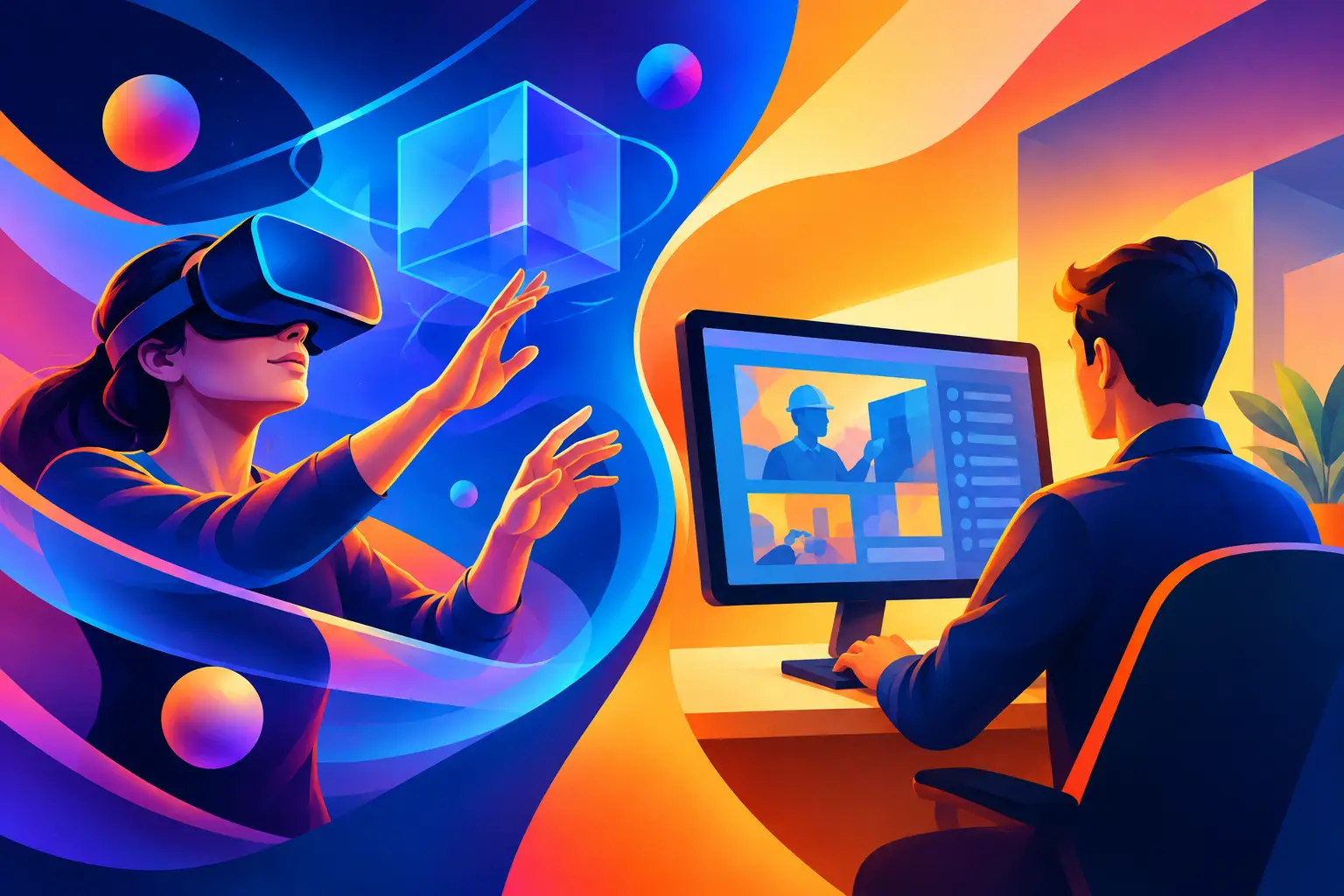
A crowded show floor gives a brand seconds to earn attention. A static backdrop may get photographed, but an augmented reality brand activation gives people a reason to stop, scan, move, play, and share. The difference is participation. AR can place a new product in a guest’s hands, turn a retail aisle into a game space, or reveal an animated layer of a campaign that only exists at the event.
For marketing teams and production partners, the opportunity is not simply to add a digital effect. It is to create a physical-digital moment that moves a business objective forward: product education, qualified lead capture, social reach, footfall, dwell time, or a stronger memory of the brand.
What an augmented reality brand activation should do
The best AR experiences start with a behavior, not a device. Ask what a visitor should do differently after engaging. Should they understand a product feature? Compare variants? Complete a challenge? Create content worth sharing? Find their way through a venue? The answer defines the interaction.
An AR activation works especially well when it makes an invisible idea visible. A beauty brand can visualize ingredients or a finished look. An automotive brand can let guests inspect a vehicle configuration at life scale. A property developer can overlay future spaces onto a physical model. A sustainability campaign can show the impact behind everyday choices.
That said, AR is not automatically the right answer for every campaign. If the story is best told through high-volume gameplay, a large interactive LED wall may create more energy. If the goal is private, detailed product training, VR can provide greater focus. AR performs when the real environment matters and the digital layer improves what is already in front of the visitor.
Choose the right AR interaction format
The technology should fit the venue, audience volume, and campaign mechanics. A mobile web AR experience is fast to access and can extend beyond the event, but it depends on a visitor’s phone, camera permissions, network quality, and willingness to scan a code. A dedicated tablet or kiosk creates more control and higher visual consistency, while requiring staffing and hardware planning.
For premium launches and exhibitions, screen-based AR mirrors can be highly effective. Guests see themselves on a large display while branded effects, virtual products, avatars, or environments appear around them. The format is instantly legible from a distance, making it useful for attracting a queue and creating visible event energy.
Spatial AR can also use markers, image recognition, depth sensing, and location triggers. A printed package may become an animated portal. A physical product plinth can trigger a guided explainer. A sequence of venue touchpoints can become a scavenger hunt that directs visitor flow. Each approach has different production requirements, so the concept must be selected early rather than bolted onto a finished campaign.
Mobile AR: reach beyond the footprint
Mobile AR is useful when the activation needs a long life. A guest can scan at an event, save a shareable asset, and revisit the experience later from retail packaging or a campaign page. It is also practical for distributed campaigns where a permanent installation is not possible.
The trade-off is friction. Every extra action reduces participation. QR entry should lead directly to a clear instruction, a fast-loading experience, and an immediate reward. Asking users to download an app for a two-minute interaction is rarely appropriate unless the app has a meaningful ongoing role.
Managed AR installations: control the moment
For high-profile events, managed hardware often delivers the strongest result. A purpose-built AR station can combine high-brightness displays, calibrated cameras, sensors, physical set pieces, custom lighting, and branded audio. It is easier to guide guests, maintain visual quality, and capture consistent data.
This format also gives agencies and brand teams more room for theatrical storytelling. A virtual mascot can greet visitors. A product can transform in midair. A game can use body movement or gestures rather than a touchscreen. The installation becomes part of the environment, not just a screen waiting to be noticed.
Build the activation around a real visitor journey
An AR experience needs a beginning, middle, and next action. The first three seconds matter most. Visitors should understand what to do before they need an explanation from staff: stand here, raise your hand, scan this object, choose a mission, or look at the display.
The interaction itself should be short enough to keep the line moving but rich enough to feel earned. For many live environments, 45 to 90 seconds is a useful target. A longer journey can work in a retail flagship, museum, or corporate visitor center where dwell time is expected. At a busy festival, an experience that takes four minutes may create a queue that limits total participation.
The final screen should not be an afterthought. It can deliver a personalized video, product recommendation, score, coupon, lead form, or invitation to continue elsewhere in the venue. If lead capture is required, earn it through value. Let guests receive their captured photo, game result, or personalized product configuration in exchange for permission-based details.
Physical design matters just as much as software. Sightlines, queue space, lighting, accessibility, acoustic conditions, device charging, internet resilience, and staff positioning can determine whether an idea feels effortless or frustrating. This is why AR production works best when creative, software, hardware, and on-site operations are planned as one system.
Design for campaign value, not just visual novelty
A floating 3D logo is technically AR, but it is not necessarily a brand experience. The digital layer needs to carry a recognizable campaign idea. If the campaign is about speed, build a timed challenge. If it is about personalization, let users create a version that reflects their choices. If the brand is introducing a complex product, use AR to reveal features that cannot be seen in a standard display.
Game mechanics can turn passive product information into a reason to engage. Points, timed missions, team play, progressive levels, and leaderboard moments are effective when they support the message. They become distracting when the guest remembers the game but not the product.
Content must also account for the real-world setting. Fine text, low-contrast graphics, and subtle audio cues may fail in daylight or a loud exhibition hall. Strong visual hierarchy, clear motion cues, and concise instructions are more valuable than a crowded interface. Design for the environment people actually occupy, not for a pristine demo room.
Measure the signals that matter
An augmented reality brand activation can generate richer insight than a conventional photo opportunity, but only if measurement is designed into the experience. Start with one primary campaign outcome and a few supporting signals.
For awareness, track total participants, unique sessions, completed experiences, content shares, and earned reach where available. For product education, look at feature selections, completion rates, quiz responses, and time spent with specific content. For lead generation, measure qualified opt-ins, conversion to follow-up, and the quality of information captured, not merely the volume of email addresses.
Operational data is equally valuable. Peak participation times can inform staffing. Drop-off points can reveal unclear instructions. Heatmaps and interaction paths can show which content attracts attention. In multi-zone events, data can help organizers improve visitor flow rather than allowing crowds to collect in one location.
Data collection must be transparent and proportionate. Explain what is being captured, obtain consent where needed, and avoid requesting personal information that the experience does not genuinely require. Trust is part of the activation design.
Plan for deployment from day one
The most ambitious AR concept is only as good as its on-site reliability. Production planning should include device specifications, fallback modes, content loading times, network contingencies, battery and power management, remote monitoring, cleaning procedures, and a clear support plan. If a live event cannot depend on venue Wi-Fi, build for offline or local-network operation where possible.
Testing should happen in conditions close to the final environment. Check the camera under event lighting. Test marker recognition on the actual printed material. Watch how people approach the interaction without instruction. Validate performance across intended devices if the experience is mobile. Small adjustments before deployment often prevent major friction on opening day.
PearlQuest approaches these projects as integrated experience systems, combining creative direction, custom AR development, interactive hardware, game mechanics, analytics, and deployment support. That integration matters when an activation has to perform under live-event pressure, not just look impressive in a concept presentation.
Make the interaction worth repeating
The strongest AR experiences leave visitors with more than a visual effect. They give people a role in the brand story: explorer, competitor, creator, collector, or informed buyer. When that role is clear, the technology becomes almost invisible and the experience becomes memorable.
Before approving the next AR concept, ask one practical question: what will a visitor do here that they cannot do with a poster, a product sample, or a standard video? Build around that answer, and the activation has a far better chance of earning attention where it counts – in the room, in the data, and in the memory people take with them.