
 Projection Rooms: The Future of Immersive Story Spaces
Brand storytelling is undergoing a fundamental shift from passive visual consumption to fully responsive, tactile environments. Across dynamic commercial hubs—from Dubai and Abu Dhabi to Saudi Arabia, Qatar, and Kuwait—marketing directors, agency owners, and innovation managers are moving beyond standard LED screens. Today, modern projection rooms represent the ultimate evolution of narrative architecture, transforming plain walls, floors, and architectural surfaces into living, interactive canvases. Audiences no longer want to just watch a video; they want to step inside the narrative, touch the visual elements, and shape the story in real time.
 Why Projection Rooms Are Redefining Modern Storytelling
Traditional event setups rely on flat displays, backdrop banners, or simple monitors. While effective in the past, these formats struggle to capture the short attention spans of modern consumers in competitive markets like Saudi Arabia and Dubai. Projection rooms eliminate the physical border of the screen, wrapping the audience in 360 degrees of imagery and spatial audio.
Breaking the Barrier of Flat Displays
When a visitor enters a seamless projection environment, their peripheral vision is entirely engaged. Advanced edge-blending software and high-lumen laser projectors merge multiple feeds into a single, cohesive spatial graphic. According to industry research on immersive spatial design published on Blooloop, multi-projection installations hold viewer engagement significantly longer than traditional single-screen digital signage.
Multisensory Engagement for Gulf Audiences
In cities known for world-class experiential retail and grand activations, such as Abu Dhabi, Doha (Qatar), and Kuwait City, standing out requires memorable immersion. High-definition projection technology can simulate everything from futuristic urban landscapes to surreal digital art installations. By adding motion-tracking sensors, floor-projection interactivity, and localized spatial sound, these spaces turn passive viewers into active participants.
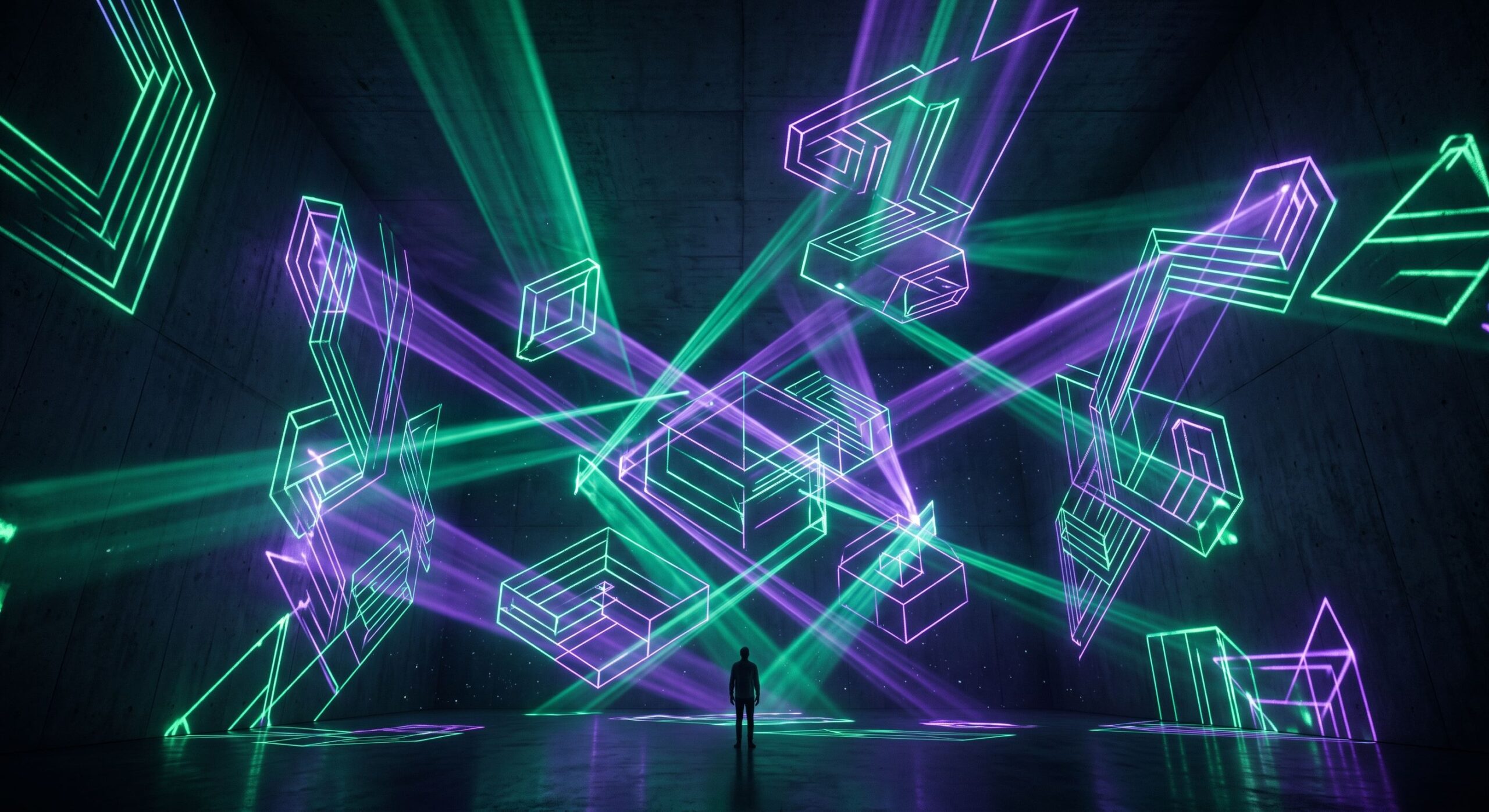
Designing Projection Rooms for High-Impact Events and Brand Activations
For CMOs, brand managers, and event agencies planning high-visibility launches across Qatar, Kuwait, and the UAE, the design of immersive projection rooms requires a thoughtful balance of creative content and hardware integration.
- 360-Degree Perspective Mapping: Wrapping visuals around corners and structural columns without distortion.
- Interactive Floor Projections: Allowing foot traffic to trigger ripples, motion trails, or reveal hidden product features.
- Spatial Audio Synchronization: Routing multi-channel sound to follow visual movement across the room.
- Real-Time Data Feeds: Updating visual themes dynamically based on audience interaction or live event telemetry.
Dynamic Content Adaptation and Spatial Audio
A successful room does not simply mirror the same video across four walls. It uses spatial perspective mapping to create depth. Content shifts dynamically based on audience density or movement. Sound is routed through multi-channel directional speakers so that visual cues match auditory prompts precisely, deepening emotional resonance.
Scalability Across Corporate and Retail Venues
One of the primary advantages of projection mapping over physical structural builds is flexibility. A single physical space can host a luxury car launch in the morning, an interactive product demo in the afternoon, and an ambient VIP networking gala in the evening—simply by switching the digital content pipeline.

PearlQuest’s Vision for Next-Generation Immersive Projection Rooms
My name is Tanveer, and as a content writer closely tracking the rapid rise of interactive technology, I see how dramatically experiential expectations are evolving across the Middle East. At PearlQuest, our team gets deeply motivated by the transformative power of immersive story spaces. We are constantly inspired by how innovative projection rooms enable brands in Dubai, Abu Dhabi, and Saudi Arabia to foster real emotional connections with their target audiences.
While execution strategies vary per activation, our vision at PearlQuest is rooted in pushing creative boundaries. We plan to keep exploring how interactive hardware, gesture recognition, and spatial media servers can seamlessly converge. For agency partners and innovation managers seeking to elevate brand activations in Kuwait or Qatar, integrating fully custom projection environments provides a future-proof foundation for unforgettable storytelling.
Key Takeaways for Marketing & Event Leadership
- Elevated Brand Recall: Immersive environments trigger higher emotional resonance and recall than static digital displays.
- Versatile Infrastructure: Digital scenes can be swapped instantly without rebuilding physical sets, saving time during high-profile events.
- Regional Resonance: Cutting-edge visual experiences align perfectly with the ambitious digital transformation strategies across Saudi Arabia, Dubai, Abu Dhabi, Qatar, and Kuwait.
As brands prepare for the next era of audience engagement, investing in state-of-the-art projection rooms ensures your narrative isn’t just seen—it’s experienced