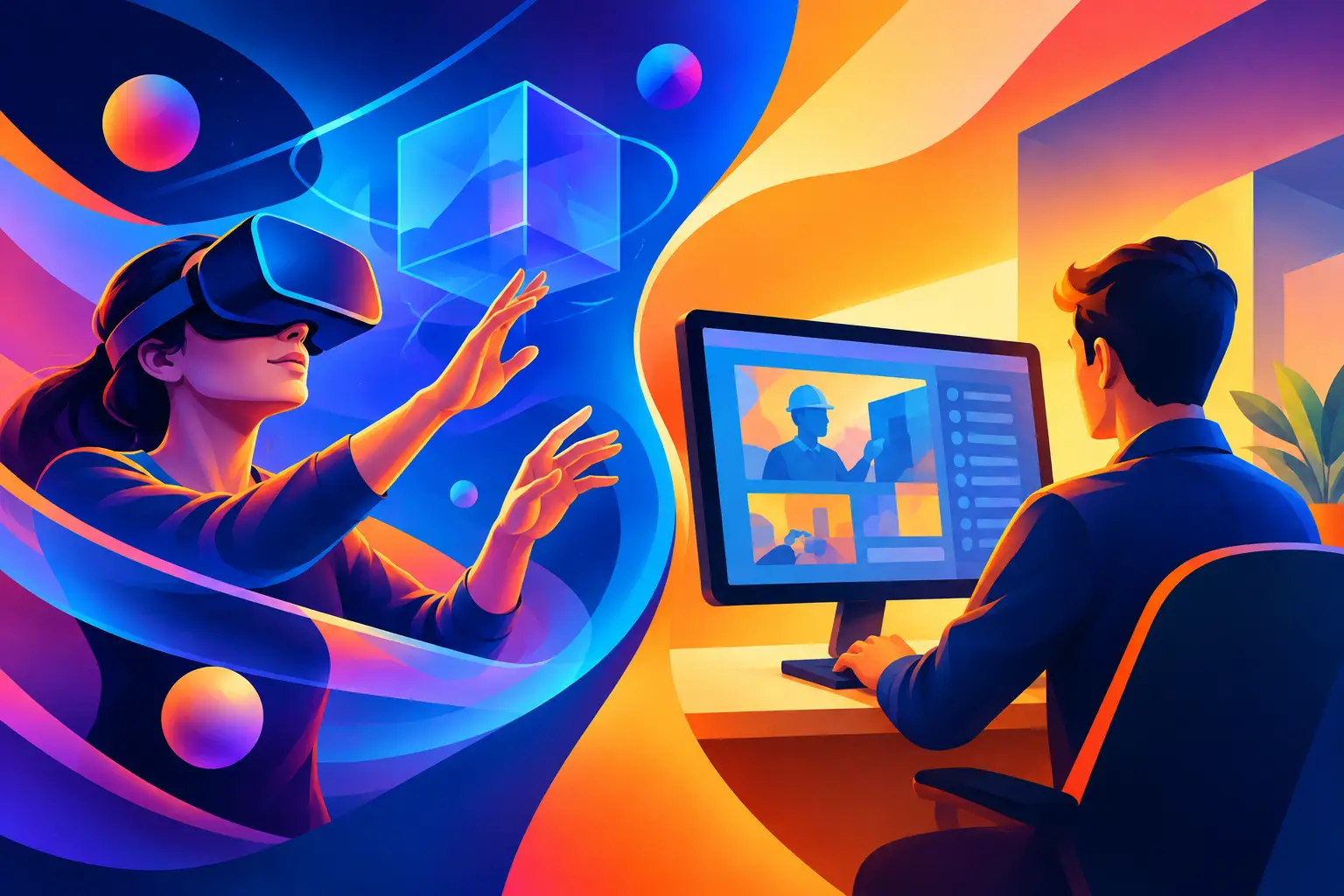
A crowded show floor gives a brand only a few seconds to earn attention. The strongest interactive brand activation ideas do not ask visitors to watch a message. They give them a role: solve a challenge, create content, test a product, influence a shared environment, or meet an intelligent digital character. That shift from spectator to participant is what makes an activation memorable – and measurable.
For event producers, marketing teams, retail operators, and agencies, the real question is not which technology looks newest. It is which interaction can express the campaign idea, work reliably in a live environment, and generate an outcome worth tracking.
Interactive Brand Activation Ideas Built for Participation
1. Gamified Product Discovery
Turn product education into a timed mission, skill game, or multi-stage challenge. A visitor might scan clues around a stand, configure a product under pressure, or match features to real-world scenarios on a large touch display.
The game mechanic needs to serve the product story. For a vehicle launch, a reaction game can demonstrate safety technology. For a financial service, a decision-based game can make complex choices easier to understand. Scores, leaderboards, and instant rewards create energy, but the most valuable moment is the product insight built into the play.
2. AI Avatar Meet-and-Greets
An AI-powered avatar can greet guests, answer campaign-specific questions, recommend an experience path, or host a branded quiz. This format works particularly well when a brand needs to communicate a large amount of information without placing staff at every interaction point.
The experience should be tightly designed, not treated as an open-ended chatbot placed on a screen. Define the avatar’s role, tone, approved knowledge base, escalation path, and visual identity. A playful beauty advisor, a virtual museum guide, and a technical product specialist require very different conversational behavior.
3. Immersive Product Story Rooms
Use projection, LED walls, spatial audio, motion sensors, and responsive content to place visitors inside a product story. A travel brand can simulate changing destinations. A real estate developer can let guests walk through an evolving future district. A sustainability campaign can show how individual decisions alter a shared digital landscape.
Immersive rooms are high-impact because they control focus. They also require careful throughput planning. A cinematic experience for six people at a time may create stronger emotional impact than a large open installation, but it can create queues during peak traffic. The right format depends on expected footfall and dwell-time targets.
4. Mixed-Reality Product Visualization
Mixed reality lets visitors see digital product layers anchored to physical objects and spaces. A retail display can reveal material options, internal features, or usage scenarios. At an exhibition, a compact physical model can become a full-scale machine, building, or industrial process through a headset or tablet experience.
This is especially useful for products that are too large, too technical, or too costly to bring to an event. The key is giving users something meaningful to manipulate: rotate a model, select configurations, compare performance states, or trigger an animated demonstration. Passive 3D viewing alone rarely holds attention for long.
5. Collaborative Interactive Walls
A large interactive wall turns a brand message into a shared activity. Guests can contribute a thought, vote on a choice, build a collective artwork, explore live content, or control visual elements through touch and gesture.
Collaborative formats create visible social proof. When people see an installation already in motion, they understand immediately that participation is welcome. For public venues and festivals, the wall can also become a living data visualization – showing audience sentiment, citywide participation, or progress toward a collective challenge.
6. Motion-Responsive Floors and Play Zones
Interactive floors reward movement. They can turn a retail atrium into a branded sport challenge, a family event into a cooperative game, or a product launch into an energetic competition zone. Sensors track footsteps and gestures while projected or LED visuals respond in real time.
This format works when the brand can credibly own movement, energy, exploration, or play. It is less suitable for a campaign that requires private consultation or detailed information capture. A strong experience design can solve this by placing a lead-capture or product consultation touchpoint immediately after the game.
7. Generative AI Content Studios
Give visitors a creative role in the campaign. In a generative AI content studio, they can describe an idea, select visual themes, add a selfie, or choose product attributes to create a personalized artwork, animation, soundtrack, or campaign poster.
The output must be worth keeping and sharing. Build visual guardrails so every creation still feels on-brand, then provide a simple delivery method such as QR retrieval, email, or on-site print. Consent language and data handling should be planned from the start, particularly when faces, contact details, or user-generated prompts are involved.
8. Smart Photo Booths With a Narrative
Photo booths remain effective because guests understand them instantly. The opportunity is to move beyond a logo overlay. Add gesture triggers, AR effects, body tracking, animated environments, or a short story sequence that makes the guest part of the brand world.
A sports brand might turn a visitor into a stadium-screen hero. A fashion launch could create a responsive editorial cover. A destination campaign may transport participants through several landmarks in a 10-second film. The best result is content that feels like a personal moment first and branded content second.
9. Tangible Tables for Group Exploration
Tangible interactive tables let people use physical objects, tokens, or product pieces to control digital content. Place a model on the table to reveal specifications. Arrange components to build a solution. Compare options with colleagues around a shared interface.
They are particularly effective for B2B exhibitions, enterprise demonstrations, learning environments, and property sales centers because they support conversation rather than isolating each visitor behind a screen. They also make technical information easier to navigate in groups, where several stakeholders may be evaluating a decision together.
10. Data-Driven Challenge Journeys
Instead of building one headline attraction, create a connected journey across multiple touchpoints. Guests collect digital stamps, complete branded tasks, answer questions, or unlock content as they move through an event, store, or venue. A final reward creates a clear reason to complete the route.
This approach is powerful when organizers need to improve visitor flow or expose audiences to several zones, sponsors, or product categories. It can reveal where guests entered, which challenges drew repeat engagement, where drop-off occurred, and which content led to qualified conversations. The journey should remain friction-light. Requiring too many registrations or steps will reduce participation.
How to Choose the Right Interactive Brand Activation Idea
Start with the behavior you want to create. If the goal is broad reach and visual spectacle, an interactive wall, responsive floor, or open immersive environment may be the better fit. If the goal is qualified lead capture or complex product education, a guided AI avatar, tangible table, or mixed-reality demonstration may produce more useful engagement.
Then design for the physical reality of the deployment. Consider peak traffic, available footprint, lighting conditions, network resilience, accessibility, staff support, cleaning requirements, and how quickly an experience can reset between users. A spectacular concept that cannot maintain throughput or recover quickly from a technical issue is a risk, not an advantage.
Measurement should be part of the creative brief, not an afterthought. Depending on the activation, relevant signals may include total participants, average dwell time, completion rate, repeat plays, content shares, opt-ins, product selections, heat maps, or staff-led conversion conversations. Not every interaction needs a form. Often, anonymized behavior data is more useful for optimizing the space while a smaller number of high-intent moments capture leads.
PearlQuest approaches these experiences as connected systems: creative story, interaction design, custom software, physical hardware, content, analytics, and on-site deployment operating together. That integration matters when an activation must look exceptional, respond instantly, and perform under live-event pressure.
The most effective activation is rarely the one with the most screens or the longest feature list. It is the one that gives people a clear reason to step forward, participate without hesitation, and leave with a story they want to tell.