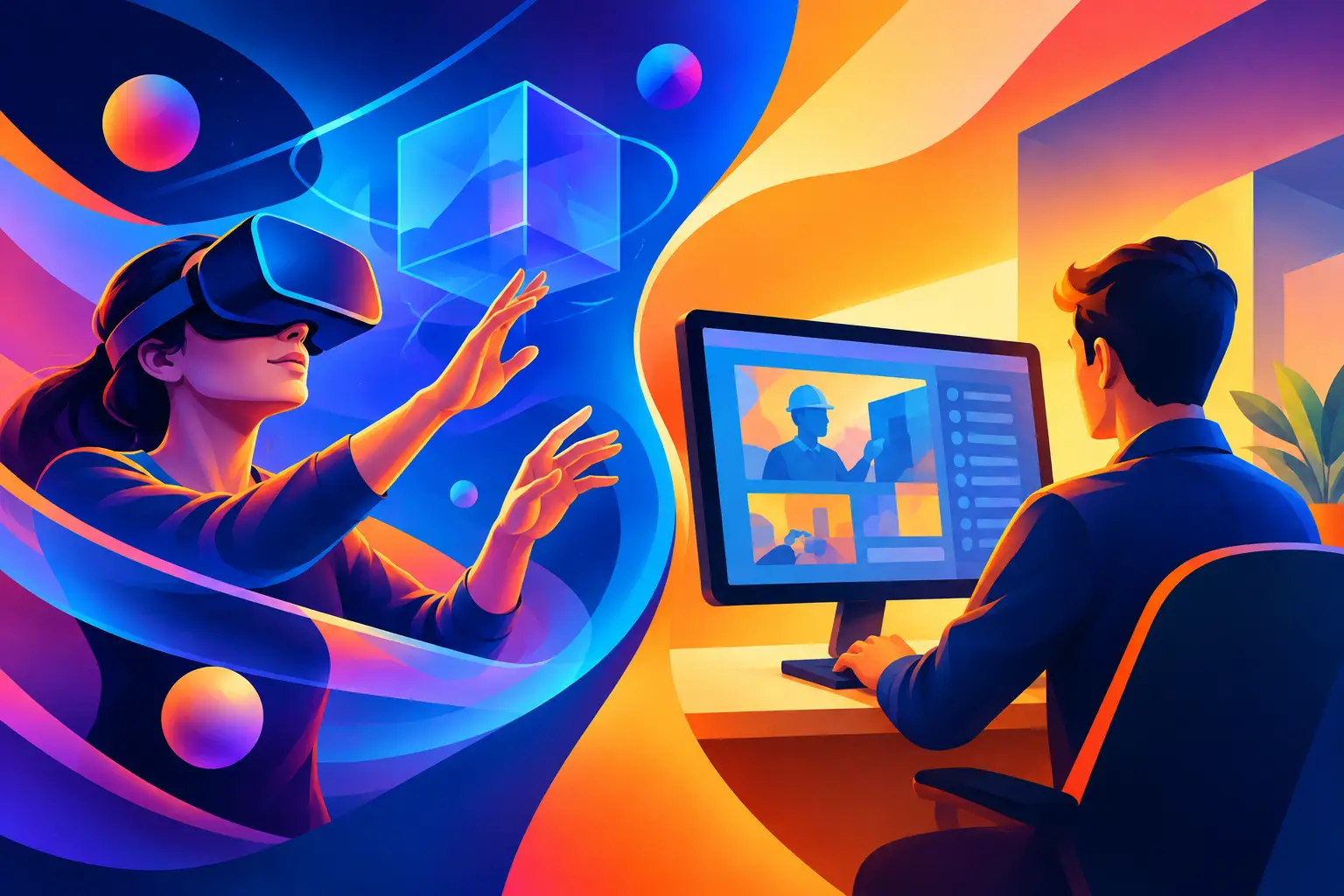
A crowded event floor gives brands only a few seconds to earn attention. Interactive event technology changes that equation by giving people something to do: test a product, compete with colleagues, create a shareable asset, speak to an AI avatar, or step inside a story space. The result is not simply a more entertaining booth. It is a designed exchange of attention, participation, and measurable intent.
For marketing leaders, event producers, and venue operators, the question is no longer whether a screen belongs at an event. It is whether the experience gives visitors a reason to stop, a clear action to take, and a reason to remember the brand after they leave.
What Interactive Event Technology Is Built to Do
Interactive event technology combines physical environments, digital content, sensors, software, and game mechanics to make an audience an active part of the experience. It can be as focused as a touch-enabled product configurator or as expansive as a projection-mapped room that responds to a visitor’s movement.
The distinction matters. Passive digital signage broadcasts a message. An interactive installation asks for a choice, then responds to it. That response creates agency. At a product launch, guests might use a tangible table to compare product features, trigger a large-format visualization, and receive a personalized recap. At a conference, an AI-powered challenge can turn complex service information into an active learning moment rather than another slide deck.
Strong projects connect three layers: a compelling creative idea, intuitive interaction design, and reliable technical delivery. Missing one creates friction. A visually impressive room with no clear visitor action becomes a backdrop. A technically advanced game with an unclear brand role becomes entertainment that does not support the campaign. Hardware without thoughtful content is just equipment.
The Formats That Create Participation
The right format depends on the event objective, the available footprint, expected dwell time, and the audience’s comfort with technology. There is no universal “best” installation. An exhibition stand handling thousands of visitors needs a different interaction model than an executive briefing center or a premium retail launch.
Immersive story spaces
LED rooms, projection environments, interactive walls, and responsive floors turn a physical footprint into a narrative environment. These formats work well when a brand needs to communicate scale, innovation, destination, or product context. A visitor can move through chapters of a story instead of reading a wall of claims.
The trade-off is throughput. Highly cinematic experiences often benefit from timed entries, defined sessions, and staff-led flow. They create stronger recall, but they need operational planning so queues do not become the dominant visitor experience.
Gamified brand engagements
Custom games, reaction challenges, quiz systems, and team competitions create a natural reason for people to engage. They are especially effective for exhibitions, sports activations, employee events, and product education where energy and repeat participation matter.
The game should be designed around a brand behavior, not pasted onto a campaign. If the objective is to introduce product benefits, the challenge can ask players to make decisions based on those benefits. If the goal is lead qualification, progressive game levels can reveal interests without making the data capture feel like an interruption.
AI-powered conversations and avatars
AI avatars, conversational kiosks, and intelligent content assistants can deliver personalized interactions at scale. They can answer questions, guide visitors through a product range, provide multilingual support, or turn a brand mascot into a responsive host.
This format is powerful when content is deep or audience questions vary widely. It also requires guardrails. The knowledge base, response style, escalation path, privacy approach, and live connectivity plan should be defined before deployment. AI is most effective when it has a specific role in the visitor journey rather than being presented as a novelty.
AR, VR, and mixed-reality experiences
Augmented reality is useful when a physical setting needs another layer of information, animation, or play. Virtual reality is better suited to experiences that cannot be easily recreated on an event floor, such as a factory walkthrough, property visualization, hazardous training scenario, or future mobility concept. Mixed reality can connect real objects and digital content in a more spatial, collaborative way.
These formats create high impact, but operational details decide success. Headset cleaning, session duration, accessibility, staff support, and reset time all affect capacity. For a busy public event, a shared-screen AR interaction may serve more people than an individual VR experience. For a VIP briefing, the opposite may be true.
Design the Visitor Journey Before Selecting the Tech
A technology-first brief often starts with a request for a hologram, an LED wall, or a VR experience. A stronger brief starts with the visitor journey. What should make someone approach? What should they understand or feel after the first interaction? What action should they take next?
A practical journey has three moments. The first is attraction: motion, sound, light, a live scoreboard, or visible participation draws people in. The second is interaction: the guest plays, explores, configures, creates, or converses. The third is continuation: a result appears on a large display, a personalized asset is delivered, a team score is recorded, or a host begins a more relevant conversation.
This structure prevents a common event problem: a crowd gathers around an installation, but nobody knows where to start. Clear prompts, visible feedback, and a short learning curve matter more than adding features. The best interactions can be understood from a few feet away and completed without a lengthy explanation.
Make Measurement Part of the Experience
Event engagement is often judged by impressions, footfall, or a stack of scanned badges. Those numbers have value, but they do not explain whether people meaningfully interacted with the brand. Interactive systems can capture richer signals when measurement is planned from the beginning.
Useful event metrics may include interaction starts and completions, average dwell time, repeat play, content selections, product preferences, score progression, opt-in rates, qualified conversations, and visitor flow between zones. A digital twin of the event environment can also help operators understand crowd movement and identify underused areas.
Data collection should always match the value offered to the visitor. If a guest gives contact details, they should receive something worthwhile: a personalized result, useful content, a competition entry, a consultation, or a follow-up tailored to their choices. Consent language must be clear, and the experience should still work for people who choose not to share personal information.
For agencies and enterprise teams, the most useful post-event report connects behavioral data to campaign objectives. Rather than stating that 4,000 people visited, it can show that a specific product pathway received the longest dwell time, that a challenge improved message recall, or that a defined audience segment requested follow-up.
Build for the Reality of Live Events
An interactive installation has to work under pressure: changing lighting conditions, variable Wi-Fi, high visitor volume, venue restrictions, shipping schedules, and a limited installation window. Creative ambition is essential, but it must be matched by deployment discipline.
That means specifying commercial-grade hardware, planning cable management and accessibility, testing the experience in realistic conditions, and creating fallback modes for connectivity or component issues. Content should be modular enough to update when campaign messaging changes. Staff interfaces need to be simple, because event teams should not need a software engineer to restart a session or explain the interaction.
This is where an end-to-end production approach earns its value. Creative storytelling, custom software, physical fabrication, sensors, display systems, content operations, and analytics should operate as one experience rather than a collection of vendor handoffs. PearlQuest approaches interactive environments this way: as deployed systems designed for people, venues, and measurable business goals.
Choose Technology That Earns Its Footprint
Not every event needs a larger screen or a more complex installation. Sometimes a well-designed tabletop challenge will generate more qualified conversations than a room-scale spectacle. Sometimes the right answer is a high-throughput photo experience with smart personalization. The choice depends on whether the priority is reach, depth, education, lead quality, social visibility, or operational flow.
The strongest interactive event technology does not ask attendees to admire innovation from a distance. It gives them a role in the story, then gives the business a clear way to understand what that participation meant. Start with the action you want people to take, and let the technology make that action impossible to ignore.